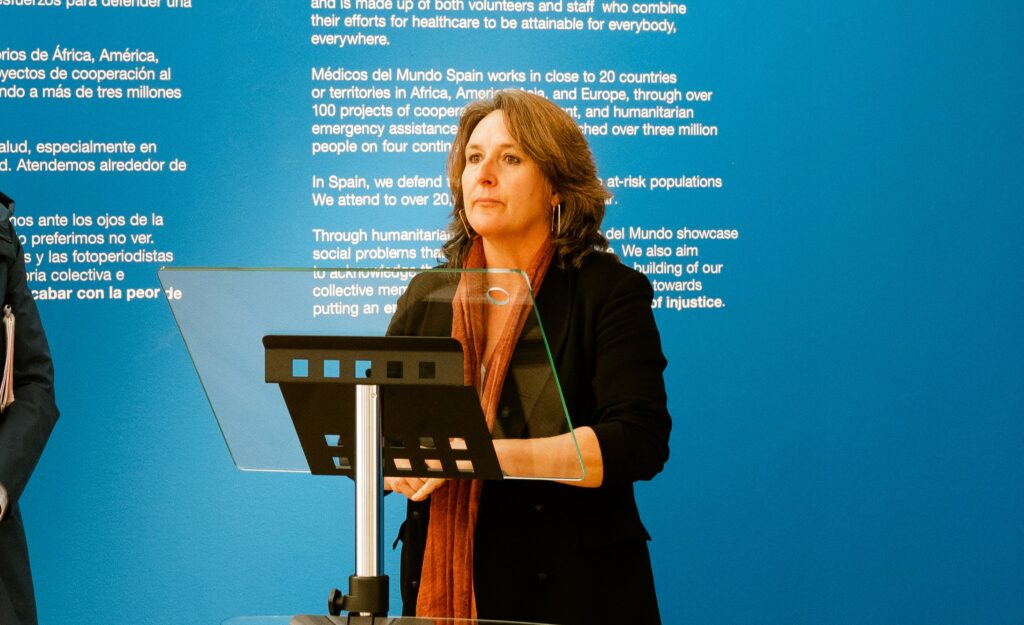


- Today we woke up to the tragic and heartbreaking news that María Clauss and her husband, journalist Óscar Toro, are among the fatalities of the Adamuz train crash.
Today we mourn the passing of María Clauss, a remarkable photographer whose gaze left a profound mark on humanitarian and documentary photography.
In 2022, when María Clauss received the Luis Valtueña Award by unanimous decision of the jury, she could not imagine the impact her work would have. The winning series, Where Oblivion May Not Dwell, is a powerful demonstration of her sensitivity and sharpness: a project that not only reconstructs the memory of the Spanish Civil War, but highlights the voices and feelings of the daughters, sons, sisters, and brothers of the victims. Her photography did not look at the past as a historical exercise, but as a living wound that continues to shape the present.
For this award and for Médicos del Mundo, the fact that María was the first and only woman to receive the prize gave the recognition a special significance. Yet she never spoke from a place of personal merit, but from commitment. Aware of her position in the field of humanitarian photography, she embraced the responsibility of encouraging other female photojournalists to tell their own stories. “I believe it is important for us to show our gaze and make our projects visible, because we have a different way of seeing,” she said, asserting a necessary and distinct voice.
María never said no. She stood with the Luis Valtueña Award with tireless generosity: she presented her work in galleries, spoke in conferes, debates, and guided visits, and was present in Barcelona, at the Menorca DocFest, at the Human Rights and Film Festival of Donostia, at the Semana Negra in Gijón, at On Photo Soria, and many other spaces. Her work crossed borders and reached Italy, where she presented her series on behalf of Médicos del Mundo and was recognized at the Lodi Ethical Photography Festival.
Her approach to photography never stopped at the technical act of pressing the shutter. Behind each project there was deep research; she set an independent objective, free from partisan or association-driven constraints, and sought to “contextualize” in order to truly understand what she was going to photograph. Her gaze was always rigorous—one that went beyond investigation and descended into everyday life, always on the side of the people she photographed.
María devoted much of her work to historical memory, but she also portrayed the lives of older women who had been prostituted, of day laborers in Andalusia, and of people made invisible by complex stories. In every case, her work was a form of resistance against oblivion: she never abandoned her subjects once the photographs were taken.
Médicos del Mundo and the Luis Valtueña Award will never forget you, María. Your personal and professional legacy will continue to illuminate our memory and remind us that photography—when carried out with honesty and humanity—can be a profound act of justice and reparation… so that oblivion may never dwell.